

Routal blog

Top list of route optimizers 2026
If your delivery operative lives in Survival mode (last-minute changes, impatient customers, new drivers every week and planners putting out fires), choose a route optimizer It's not about “putting directions on a map”. It Goes From Reduce stress, Standardize processes And Keep the service stable, even when the day turns twisted.
And here comes the uncomfortable part: In many companies, the “route optimizer” is still a person. The typical essential figure: “Leave it to X, who knows the city better than Google”. Spoiler: it's usually expensive.
In this article I leave you a Comparative list of optimizers 2026, highlighting Routal And comparing it to Circuit, Route4Me, Onfleet... and with the most common (and dangerous) alternative: manual planning.
The real problem with the cast: low training, high turnover and a very stressful environment
In the last mile, chaos is no exception: it's context.
- Drivers with Little Training (or Too Little Time to Train): you need the tool to be intuitive from minute 1.
- High turnover: if your operations depend on “key people”, every loss breaks your service.
- Operational stress: incidents, absences, peaks in demand, time windows... everything requires reacting quickly without losing control.
- Invisible cost: “Where's my order?” calls, redeliveries, extra kilometers and planners redoing routes by hand.
A good route optimizer doesn't just calculate the “shortest” order. It also helps you to Operate with Rules, monitor And Communicate ETAs with reliability.
What a route optimizer should have in 2026
If you're comparing tools, these are the capabilities that (today) make the difference:
- Real usability: let the planner plan quickly and the driver doesn't get lost (or fight with the app).
- Complex restrictions: time windows, capacity, zones, priorities, service times, skills, etc.
- Reoptimization and incident management: last-minute changes without blowing up the day.
- Real-time monitoring and operational visibility.
- Communication with the customer: tracking and ETAs (fewer calls, more trust).
- Constant support: when something happens, you need a response (not a “queued ticket”).
Comparison: Routal vs manual vs Circuit vs Route4Me vs Onfleet
1) Routal: the simplest, most efficient solution with the best support
Routal is designed to make the operation work Even if the equipment changes And the day comes crooked: quick planning, powerful restrictions, monitoring and communication, without turning the tool into a master's degree. Routal is positioned as a complete platform for Optimize and Monitor Last-mile operations and Communicate the estimated time of arrival In a precise way.
Where it shines especially
- Usability: plan routes in a very short time (without “setting up an airplane”).
- Complex operations with restrictions: time windows, capacities, zones, priorities, service times... (without going crazy).
- Support and support: a live, operation-oriented help center (planner, constraints, drivers, customers, integrations).
- Comprehensive platform: from planning to delivery and customer experience (and with integration capacity).
Impact when there is little training and high turnover
With Routal, you reduce dependence on the “hero employee”: anyone on the team can plan and execute according to rules, not memory.
Positioning data (if you want to use it in marketing): Routal reports savings of “+30% gas” and “90% of time” in planning/management, in addition to monitoring and communicating ETA. Use it as a claim with context (depends on the use case).
2) Manual optimizer: “the person who knows everything”... but is not as good as you think
Manual planning usually seems cheap because it already “exists”: someone with experience, an Excel, WhatsApp and Google Maps. But in 2026, that system has serious side effects:
What usually happens
- It Doesn't Scale: the more stops, the more chaos.
- It is not reproducible: If that person is missing, drop the service.
- It doesn't really optimize: Intuition doesn't calculate all possible combinations (let alone with restrictions).
- It Eats Your Margin: extra kilometers + redeliveries + time planner redoing routes.
- It increases stress: because everything depends on putting out fires manually.
If your company lives with turnover, peaks in demand or strict time windows, the manual ceases to be “artisanal” and becomes An Operational Risk.
3) Circuit (Circuit/Spoke): more basic at the functional level, great user experience
Circuit usually stands out for Simple user experience, especially for less complex scenarios or small teams. There is recent content that describes it as a tool designed to simplify planning, with a clear and easy interface for drivers.
When It Fits
- If you prioritize Facility and you don't need too much operational complexity.
- If your operation is more “linear” (fewer restrictions, fewer exceptions).
Where it may fall short
- When You Need Advanced Rules, complex restrictions or a lot of operational flexibility.
- When you go from “planning” to Manage Operation in Real Time with incidents.
4) Route4Me: very complex, many add-ons, high price
Route4Me is known for being powerful and with a large ecosystem, but its own structure of plans and packages may involve more complexity of purchase and configuration (model with different options/packages).
When It Fits
- Organizations that want a highly configurable “lego” and are willing to invest time in implementation and learning.
Where it slows down in stressful environments
- In operations with Little Training Or High turnover, complexity translates into friction.
- If every need is solved with an add-on, it's easy for cost and maintenance to grow.
5) Onfleet: specialized in on-demand (dispatch, tracking and POD)
Onfleet is clearly positioned as a last-mile management platform, with real-time tracking, customer notifications and proof of delivery (POD), in addition to auto-dispatch/optimization oriented to dynamic scenarios.
When It Fits
- If your operation is very On-Demand (orders come in all the time and you assign the “best” driver in real time).
- If you prioritize visibility, POD, and communications.
Where it may not be your best option
- If your main challenge is Complex planning (lots of restrictions and fine rules) and you're looking for a balance between power and ease for the team.
Quick summary (in case you're deciding this week)
- Do you want the best balance between usability + power + support for operating with stress and rotation? → Routal.
- Are you looking for something simple and with good UX for less complex cases and little support? → Circuit.
- Do you need a very “enterprise”, configurable system, with more complexity and possible add-ons? → Route4Me.
- Are your operations on demand and do you value dynamic dispatch? → Onfleet.
- Are you still doing manual planning? → eye: this is usually the biggest bottleneck in 2026.
Why Routal usually wins in companies with complex operations (without killing the team)
When there are low training, high turnover and stress, what you need is not “a tool with a thousand buttons”, but one that:
- Sea Easy to Adopt,
- Holder Real Restrictions,
- I'll Give You Real Time Control,
- And have Constant Support when the day gets complicated.
That's exactly where Routal usually stands out.
If you are comparing a route optimizer For 2026, the key question is:
Do you want a tool that your team will actually use, even when people change and plans change?
Routal is designed for that. If you want to know the tool, you can request a demonstration without obligation here.
%20(30).webp)

Open innovation is becoming an established trend among all corporations. If you're a corporation and don't have an open innovation contest, this means you're missing out on the next wave of changes that could cause your current business to die sooner than expected.
Volkswagen understood that and recognized that finding the best innovations that benefit its business will probably have to come from outside the company, which is why it launched its open innovation competition in which +400 startups were present and from which we were selected to be among the top 10 innovators in logistics.

Top 10 logistics innovators of 2019
The selection process was challenging: We had to go through different departments of the Volkswagen logistics group in addition to their factories, talking to their employees, trying to understand their needs and complaints and adapt them to our technology. In the end, they selected the 10 best companies that will directly impact their logistics operations and on May 14, SmartMonkey will be at the IPM logistics innovation event with the rest of the winners. This represents an honor for us and we would like to thank Volkswagen for this great opportunity.
But for now, the question I want to discuss is:
“Do all corporations need an open innovation contest?”
From my point of view, I would say no. Most companies are not yet ready for this disruptive field, not even their top managers! Because to be involved in innovation, you must first believe in its essence, from top to bottom; from the CEO to the lowest level of responsibility. This means that everyone must be willing to allocate a budget, efforts and resources and especially to receive the FAIL with open hands because innovation will inevitably cause people to fail, if that's not the case then maybe you're not innovating.
Failure is part of the game. Talk to Edison and his 999 ways not to make a light bulb. If top management is a firm believer in innovation, then innovation must be part of the company's culture. Once achieved, people will give more of their time and themselves to bring their best ideas to the company, even if there is a risk of failure. From the bottom up, innovation comes when employees believe in that culture.
There are a lot of examples that illustrate this, but there is only one that struck me personally: In Aigües de Barcelona; In the water service company that is part of the Suez group, there was that man who spent several weekends of his free time working at home, designing a tool to open sewers so that he wouldn't get hurt by repetition. He was one of their foremen, so he served as a role model for the rest of the employees to begin to innovate and provide new ideas that would improve their lives. The company believed in him, in his ambition and in his idea, and even dedicated resources to developing it, testing it and putting it into practice to encourage others to start taking initiatives as well.
Companies where failure is not accepted, in which people simply do what they are supposed to do, in which no one is taking risks, are in danger: their jobs are at risk, not because they are going to be fired, but because the market is not waiting for anyone. It's a matter of time and changing the inertia of companies over several years is no easy task.
SmartMonkey has been in numerous corporate open innovation competitions of different types: Aigües de Barcelona, Heineken, Cofares, Volkswagen, to name just a few and what I can tell you from my own experience, this is one of the ways to start working with open innovation. Innovation: While investors are looking for the unicorn, trying to fill their transaction flow, companies have the same difficult task; it takes time and it's very difficult to see potential matches between corporations and startups, but someone must do it. So my personal advice for senior management will be to assign one of the most experienced people in the company; someone with the big picture in mind, someone who knows the internal processes perfectly or at least has experience in several departments, to be responsible for the fit between the company and the startups. You need to be a leader, be reliable and be on good terms with other employees because you will ask for help, ask for favors or have to cut through internal bureaucracy. Give that person support and innovation will appear.
Last but not least, my last tip is for startups: if you don't know people from operations but only see people from marketing or communication departments, RUN (unless your products and services solve marketing problems). Sure, they'll convince you because of the amount of possibilities you have, but trust me, this is just to illustrate, they don't plan to do any business behind those meetings, they just do it because they should. I call that “The entrepreneurial show business” — “The entrepreneurial show”. So, believe me, don't waste time and run.

Reduce costs and maintain quality of service with AI-based geo-coding
Hello, I'm Xavi Ruiz, CEO of Routal . Last week I was talking to Muthu about Geoawesomeness About what we do in Routal. During this conversation, I commented that non-geographic specialists have problems due to their lack of knowledge about geographic coding systems. They think it's no longer a problem, so when you talk to them about the quality of their master data they say: “Let's go! We have Google Maps, right?” It's a normal reaction!
The magic wand of geocoding
Google has a good reputation as a technology giant and works well in urban settings. But if we ask them “Have you ever gotten lost using Google Maps?” triggers bad experiences in their minds. I'm a big user of Google Maps and I can identify with that.
The main question that comes up is why do Google Maps users trust their geocoding so much?
Geocode , for non-experts, means providing the geographical coordinates corresponding to a location.
They trust Google Maps for their expertise. They don't understand how it works and for them it's magic: they enter an address and Google magically puts a pin on a map. The magic feels perfect!
But the bad news is that Google Maps is far from perfect.
A study by the University of Pittsburgh (2009) on market quality concludes that geocoders do not offer sufficient quality. In short, 60% of the data is accurate enough (< 200 m), 20% has enough error, which is useful for a route optimizer, and the rest is not even a result (manual geocoding is still necessary) .* (See reference at the end of the post)
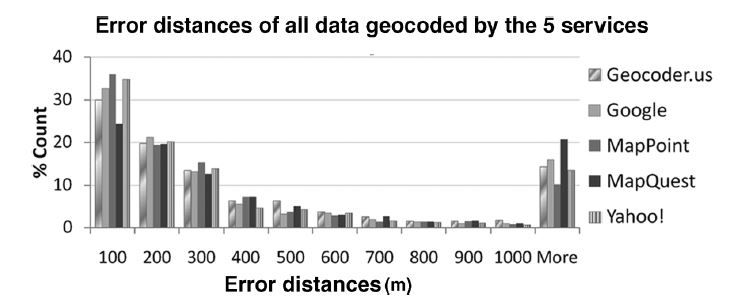
Achieving 60-70% correction is far from magical or perfect.
Logistic operations cannot be based on results with an error close to 30% in geolocated locations.
When geocoding meets reality
Why isn't Google working? magically ? There are several reasons:
- The main reason is the lack of information in the field compared to urban areas.
- Another reason is that names change. The administration changes the name of streets, squares and avenues over time. Information must be up to date. And the system should keep in mind that users can still search for old names when they think of a place. Sometimes places have cozy names that are familiar to the townspeople. But these places don't exist for Google Maps.
- Multilingual regions they have different translations and multiple combinations for the same place.
Living in the Non-Existent Star
I have a personal story to tell as an example of this problem with Google Maps.
My wife lived in a town near Girona called Olot. This region is famous for its political majority towards Catalan nationalism. My wife lived in a square officially called “Plaça Espanya”. To avoid this name, the inhabitants of Olot refer to it with the cozy name of “Plaça Estrella”. There's no need to ask why.
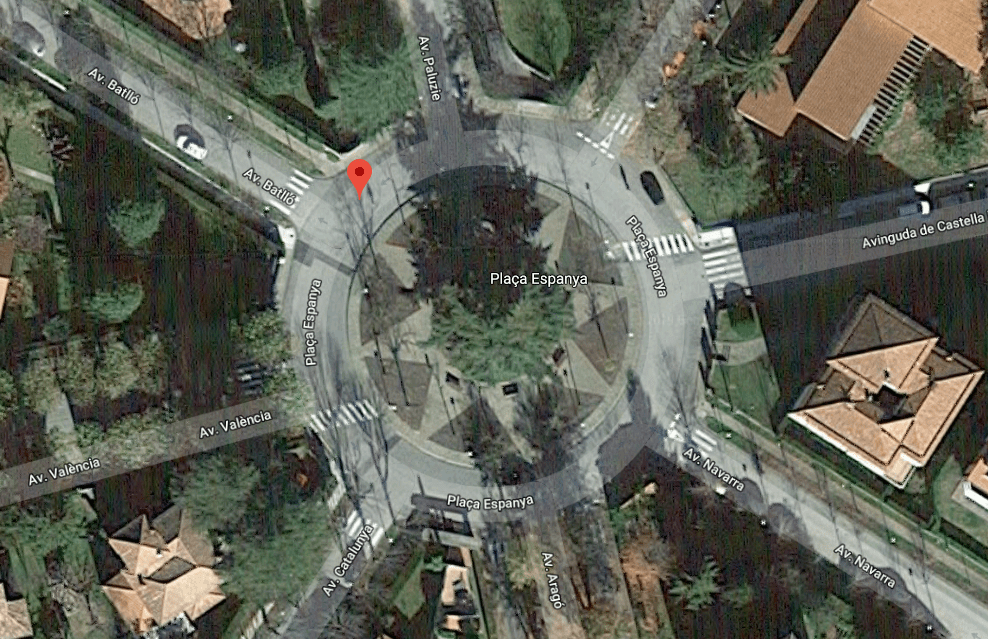
Now you can imagine the enormous problems that DHL or UPS workers had to deliver to this square!
Trust in human knowledge
How are people currently solving this problem? Obviously making mistakes and learning from them. It's that simple because none of us were born with full knowledge. Knowledge about places is acquired and shared between people. Human knowledge fills information gaps.
Since people make mistakes, 100% quality service cannot be achieved with this method.
Loss of information
Not only do workers make mistakes, besides, they aren't always available. The efficiency of operations is highly dependent on experienced people. This shared knowledge is one of the most valuable assets of a logistics company. They realize the value of their workers when they have to replace them. It is impossible to replace knowledge and at the same time maintain a consistent level of service quality.
This is a huge risk for companies that are not aware of this problem.
Artificial intelligence to the rescue
Artificial Intelligence is able to learn from operations as humans do. It learns automatically, without errors, and AI is always available. Routal helps companies in their logistics operations and reduces their costs by up to 30%.
Case Study: Suez
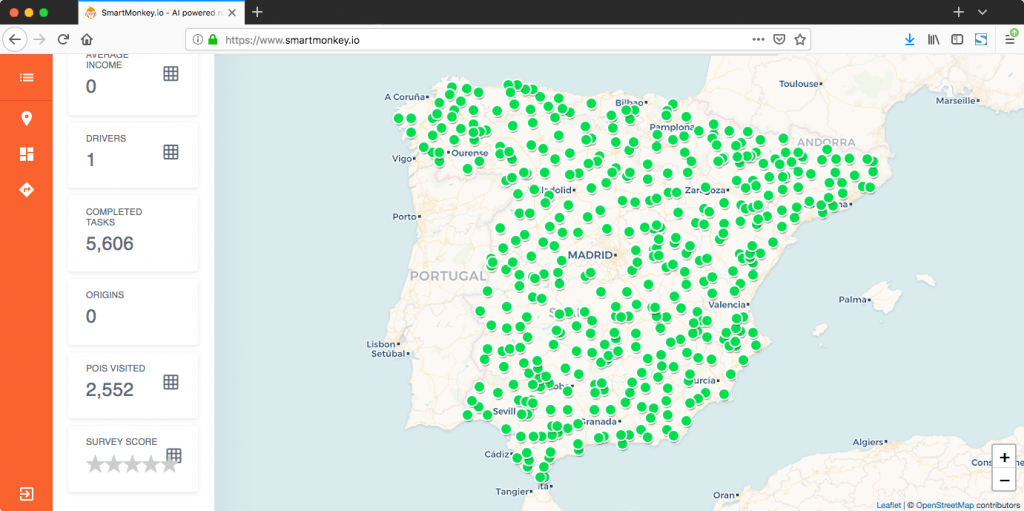
Suez is the world's largest utility company. As a water supplier, they have hundreds of thousands of places they visit periodically: water meters, valves and others.
Case Study: Suez
In some remote areas, there is only one person responsible for all of the company's operations. A single person has the knowledge of geolocation. Finding these water meters and valves is a real challenge. Google Maps won't be of any help.
Suez faced the problem when it was necessary to replace a worker. Routal demonstrated that AI helps maintain service quality and reduce risk, time and money.
How did we do that? Routal processed the GPS route of Suez logistics and combined it with commercial data (water meter readings) to automatically geolocate the places to visit. The result was:
- More than 99% of the locations were geolocated with a maximum distance accuracy of 25m.
- 60% with a maximum distance accuracy of 2m
The automatic capture of knowledge makes information more reliable and provides clear information about the operation.
Routal helps companies overcome challenges when it comes to geolocating and optimizing routes.
Visit our website to learn more about our solutions.
Stay tuned for our next article on human behaviors!
* * * Reference * * *
Roongpiboonsopit, D. and Karimi, HA , 2009. Evaluation and comparative analysis of online geocoding services. International Journal of Geographic Information Sciences , 24 (7), pp. 1081-1100. Source: https://www.tandfonline.com/doi/abs/10.1080/13658810903289478
Today we live in a new era of transformation in human history. We are impacted by the digital revolution that is redefining many aspects of modern life around the world.
And Artificial Intelligence is playing a fundamental role in several fields. From transportation and logistics to healthcare, customer care and home maintenance.
Evolution of Artificial Intelligence and its benefits
From sci-fi movies to real life, AI has come out of research labs to become an environmental part of our personal lives:
Nearly 60% of organizations use AI in one form or another and it's predicted to affect every segment of our lives by the end of 2025, with notable implications for industries.
For example, by analyzing patient data, AI can make predictive diagnoses in the field of healthcare; what's more, by analyzing student data, it provides teachers with information about their performance and advice on how to improve them and improve studies, to name just a few.
And then you can see how AI evolved from being just a term coined in 1956 to focusing on specific problems in 2016.

Therefore, if there is a conclusion to be drawn, it will be that AI will greatly benefit all industries; it will make life easier in certain areas where data analysis is necessary. Already today, AI is closely connected to customers, to the functions of companies, to online and offline retail, and is making its way into the field of logistics that is beginning its journey to become an industry driven by AI, as Routal has demonstrated in its different products. That's why there's every reason to believe that now is the best time for the logistics industry to adopt AI:
-First, technological advances in various fields such as machine learning, big data and connectivity have improved performance, accessibility and The costs of AI are more favorable than ever.
-Second, the network-based nature of the industry provides a natural framework and a good opportunity to implement and scale AI. -And last but not least, let's not ignore that all companies are moving towards the use of AI, so not adopting it will put your company at risk of long-term obsolescence.
Artificial intelligence and logistics
In a deeper approach, logistics companies are particularly positioned to benefit from the application of AI in almost every aspect of the supply chain thanks to the large volume of data that is generated daily and that allows AI to exploit it to provide the company with detailed information. In addition, logistics companies rely on networks and routes that must work harmoniously between large volumes, low margins and urgent deadlines; AI offers logistics companies the ability to optimize the composition of the network to degrees of efficiency that cannot be achieved with human thought alone. It also helps the logistics industry to redefine current practices, taking operations from reactive to proactive, planning from forecasting to prediction, processes from manual to autonomous, and services from standardized to personalized. Here are some examples to prove this:
-Increased real time Decision making: Logistics teams are often faced with repeatable actions and a wide range of operations that require the entry of a large amount of data, so combining between potential candidates fit to take responsibility for that, routes and schedules will take time, but with AI, supply chain professionals can automate the analysis and limit their selections to just two or three in a matter of seconds.
-Predictive analytics: When will customers be ready to order? This is a question that every seller asks himself, but it also represents vital information for logistics, supply chain and transportation planning to be ready when the time comes. With AI, the sales team and the logistics team will determine when an order will be placed, the route to follow, and the deadlines.
-Strategic Optimization: Where, When and How? Making the best decision in terms of transportation assets, knowledge, points from origin to customer location, schedule and savings in time, kilometers and fuel will require the intervention of AI.
Here are some examples of how AI and machine learning can process data and then present a variety of scenarios for optimization. With sophisticated tools that continuously learn and improve, industry professionals can make better and more up-to-date decisions, as well as more informed long-term strategic options, such as fleet size, optimized routes, etc., but the future is still fraught with challenges to overcome and opportunities to exploit.

On-demand delivery is an industry that is growing at a very high speed. New companies appear every day, especially in the food and beverage market and the delivery of fresh products. And the competition is wild. Efficiency is a key metric in the “I want it all and I want it now” era and the most critical part is what happens from when a new order is placed until it is delivered.
Today I want to focus on the problem of sending new orders, that is, how to decide which courier the order should be assigned to when an order enters the system. This is because today shipping is not addressed in a systematic way. Optimizing the dispatch system can minimize delivery time and improve customer satisfaction.
The operating paradigm of companies that deliver on demand can be divided into two different types:
- Deliveries based on a single deposit are those operations focused on a warehouse. This warehouse has several messengers and the programming is done once for an order list; normally grouping orders by zones. Amazon Prime is a good example of this operating paradigm.
- Deliveries based on multiple deposits are those operations that depend on picking up the order in one of the multiple warehouses and delivering it to a customer. In this case, the messengers are scattered around the city and, once a new order arrives, it is assigned through a dispatch process to one of the multiple messengers. Companies such as Uber, Just Eat, Delivero , etc. operate this way.
The problem of the office is solved with greater or lesser success in the first scenario, due to the possibility of linking together a list of deliveries and treating it as a Common traveler problem with some restrictions prior to bundling ( OK, I know that TSP is a really expensive problem, but... come on, it's Amazon ).
On the contrary, in the second scenario it is not so clear that the problem is being optimally addressed. How can a new incoming order be added to a running scenario? There are tons of variables to consider:
- Can the courier make several collections before starting to deliver?
- Can an already assigned order be reassigned to another courier?
- Do all orders have the same priority? ( for example, all orders must be delivered no later than 30 minutes after placing )
- Do orders need to be delivered by a particular vehicle?
- ...

Modeling this scenario can be quite a challenge and that's why SmartMonkey you have been working on this problem for a while. We call our solution Online Programming Optimization Model (OSOM) (Yes, branding isn't one of our strengths 😅, but phonetically it sounds like “incredible” and that's pretty fun). OSOM can model business limitations and find a viable solution to the dispatch problem.
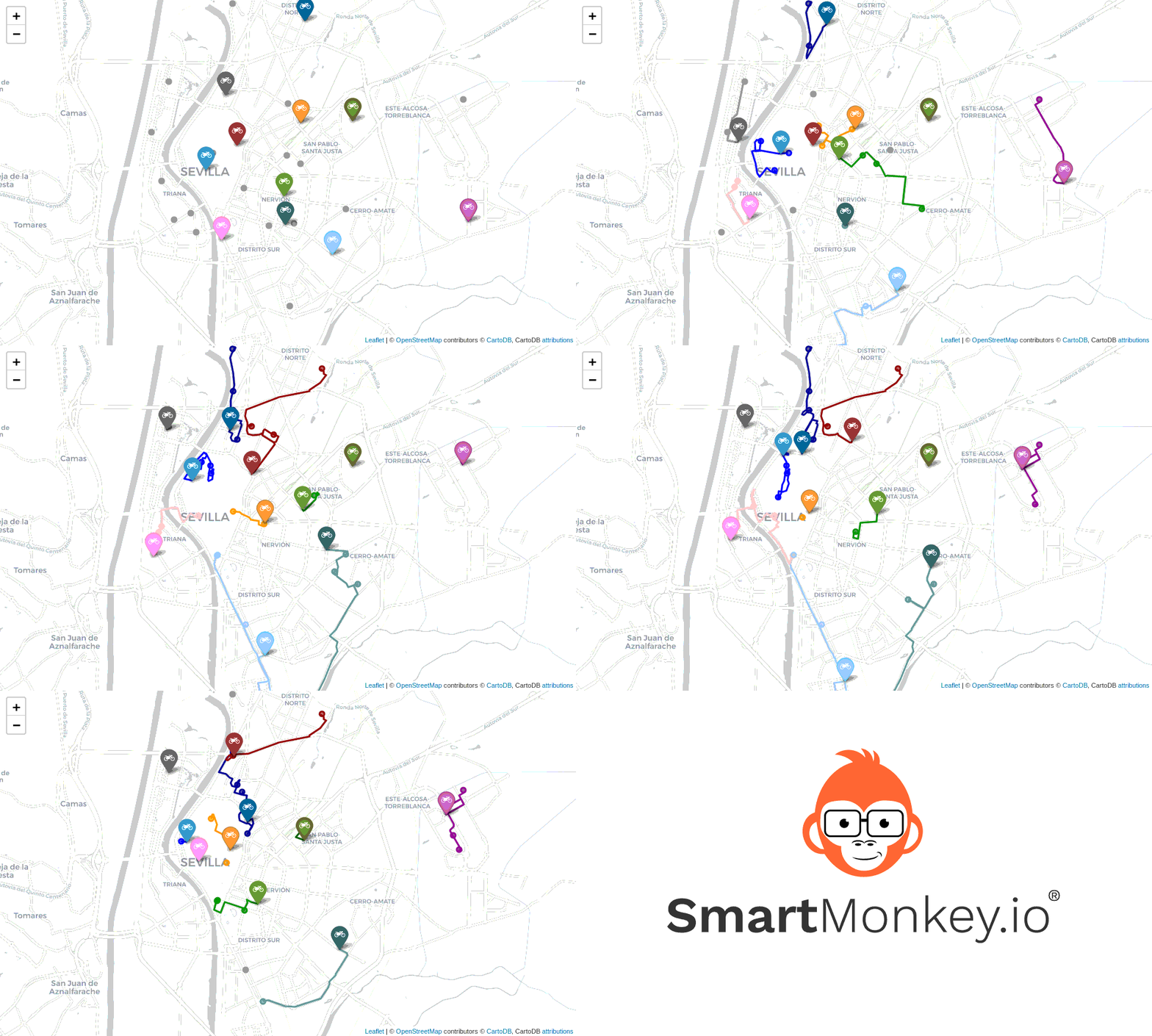
In the simulation below, we have modeled a world where:
- A courier can be assigned several pickups and deliveries at once.
- and the first next service in each message is fixed and cannot be reassigned in subsequent iterations.
The visualization contains twenty iterations of the world divided into Two steps :
1. New incoming services are marked in gray.
2. Services are dynamically assigned to messengers to optimize total delivery time.
Sorry, no blog posts were found for your query.
Move the world smarter


.png)


