

Routal blog

Top list of route optimizers 2026
If your delivery operative lives in Survival mode (last-minute changes, impatient customers, new drivers every week and planners putting out fires), choose a route optimizer It's not about “putting directions on a map”. It Goes From Reduce stress, Standardize processes And Keep the service stable, even when the day turns twisted.
And here comes the uncomfortable part: In many companies, the “route optimizer” is still a person. The typical essential figure: “Leave it to X, who knows the city better than Google”. Spoiler: it's usually expensive.
In this article I leave you a Comparative list of optimizers 2026, highlighting Routal And comparing it to Circuit, Route4Me, Onfleet... and with the most common (and dangerous) alternative: manual planning.
The real problem with the cast: low training, high turnover and a very stressful environment
In the last mile, chaos is no exception: it's context.
- Drivers with Little Training (or Too Little Time to Train): you need the tool to be intuitive from minute 1.
- High turnover: if your operations depend on “key people”, every loss breaks your service.
- Operational stress: incidents, absences, peaks in demand, time windows... everything requires reacting quickly without losing control.
- Invisible cost: “Where's my order?” calls, redeliveries, extra kilometers and planners redoing routes by hand.
A good route optimizer doesn't just calculate the “shortest” order. It also helps you to Operate with Rules, monitor And Communicate ETAs with reliability.
What a route optimizer should have in 2026
If you're comparing tools, these are the capabilities that (today) make the difference:
- Real usability: let the planner plan quickly and the driver doesn't get lost (or fight with the app).
- Complex restrictions: time windows, capacity, zones, priorities, service times, skills, etc.
- Reoptimization and incident management: last-minute changes without blowing up the day.
- Real-time monitoring and operational visibility.
- Communication with the customer: tracking and ETAs (fewer calls, more trust).
- Constant support: when something happens, you need a response (not a “queued ticket”).
Comparison: Routal vs manual vs Circuit vs Route4Me vs Onfleet
1) Routal: the simplest, most efficient solution with the best support
Routal is designed to make the operation work Even if the equipment changes And the day comes crooked: quick planning, powerful restrictions, monitoring and communication, without turning the tool into a master's degree. Routal is positioned as a complete platform for Optimize and Monitor Last-mile operations and Communicate the estimated time of arrival In a precise way.
Where it shines especially
- Usability: plan routes in a very short time (without “setting up an airplane”).
- Complex operations with restrictions: time windows, capacities, zones, priorities, service times... (without going crazy).
- Support and support: a live, operation-oriented help center (planner, constraints, drivers, customers, integrations).
- Comprehensive platform: from planning to delivery and customer experience (and with integration capacity).
Impact when there is little training and high turnover
With Routal, you reduce dependence on the “hero employee”: anyone on the team can plan and execute according to rules, not memory.
Positioning data (if you want to use it in marketing): Routal reports savings of “+30% gas” and “90% of time” in planning/management, in addition to monitoring and communicating ETA. Use it as a claim with context (depends on the use case).
2) Manual optimizer: “the person who knows everything”... but is not as good as you think
Manual planning usually seems cheap because it already “exists”: someone with experience, an Excel, WhatsApp and Google Maps. But in 2026, that system has serious side effects:
What usually happens
- It Doesn't Scale: the more stops, the more chaos.
- It is not reproducible: If that person is missing, drop the service.
- It doesn't really optimize: Intuition doesn't calculate all possible combinations (let alone with restrictions).
- It Eats Your Margin: extra kilometers + redeliveries + time planner redoing routes.
- It increases stress: because everything depends on putting out fires manually.
If your company lives with turnover, peaks in demand or strict time windows, the manual ceases to be “artisanal” and becomes An Operational Risk.
3) Circuit (Circuit/Spoke): more basic at the functional level, great user experience
Circuit usually stands out for Simple user experience, especially for less complex scenarios or small teams. There is recent content that describes it as a tool designed to simplify planning, with a clear and easy interface for drivers.
When It Fits
- If you prioritize Facility and you don't need too much operational complexity.
- If your operation is more “linear” (fewer restrictions, fewer exceptions).
Where it may fall short
- When You Need Advanced Rules, complex restrictions or a lot of operational flexibility.
- When you go from “planning” to Manage Operation in Real Time with incidents.
4) Route4Me: very complex, many add-ons, high price
Route4Me is known for being powerful and with a large ecosystem, but its own structure of plans and packages may involve more complexity of purchase and configuration (model with different options/packages).
When It Fits
- Organizations that want a highly configurable “lego” and are willing to invest time in implementation and learning.
Where it slows down in stressful environments
- In operations with Little Training Or High turnover, complexity translates into friction.
- If every need is solved with an add-on, it's easy for cost and maintenance to grow.
5) Onfleet: specialized in on-demand (dispatch, tracking and POD)
Onfleet is clearly positioned as a last-mile management platform, with real-time tracking, customer notifications and proof of delivery (POD), in addition to auto-dispatch/optimization oriented to dynamic scenarios.
When It Fits
- If your operation is very On-Demand (orders come in all the time and you assign the “best” driver in real time).
- If you prioritize visibility, POD, and communications.
Where it may not be your best option
- If your main challenge is Complex planning (lots of restrictions and fine rules) and you're looking for a balance between power and ease for the team.
Quick summary (in case you're deciding this week)
- Do you want the best balance between usability + power + support for operating with stress and rotation? → Routal.
- Are you looking for something simple and with good UX for less complex cases and little support? → Circuit.
- Do you need a very “enterprise”, configurable system, with more complexity and possible add-ons? → Route4Me.
- Are your operations on demand and do you value dynamic dispatch? → Onfleet.
- Are you still doing manual planning? → eye: this is usually the biggest bottleneck in 2026.
Why Routal usually wins in companies with complex operations (without killing the team)
When there are low training, high turnover and stress, what you need is not “a tool with a thousand buttons”, but one that:
- Sea Easy to Adopt,
- Holder Real Restrictions,
- I'll Give You Real Time Control,
- And have Constant Support when the day gets complicated.
That's exactly where Routal usually stands out.
If you are comparing a route optimizer For 2026, the key question is:
Do you want a tool that your team will actually use, even when people change and plans change?
Routal is designed for that. If you want to know the tool, you can request a demonstration without obligation here.
%20(30).webp)

We know how hard your day to day is. Planning routes is a tedious job that requires a lot of concentration and experience. From Smartmonkey.io we want to help you, that's why we launched a series of training pills to help you improve day by day. Our goal is for you to plan better, faster and more successfully.
Shall we start?
In this pill we are going to show you how one of our customers uses Highway. The before and the after. But the most interesting thing is the impact it is having on its logistics thanks to the use of route optimization technology. I'll give you a heads-up, they've succeeded reduce logistics costs by 21%, improve the Deliveries on time and go from 83% to a +95% and increase productivity of the routes in a +27%, among other benefits.
This is the webinar we did together with the ICIL Foundation where we present the success story of Canasta Rosa. It's a bit long (16 min), but I encourage you to see it all worth it 😉
00:00 Smartmonkey.io presentation
09:00 Success Story by Canasta Rosa
14:43 Pink Basket Results
18:54 Highway platform demonstration
25:00 Attendee Questions
If you have questions, don't hesitate to send us an email or ask us through our chat, our service is what makes us different, so don't hesitate to ask us!
We hope it was useful and we look forward to seeing you next week with more pills to improve your daily efficiency!

We know how hard your day to day is. Planning routes is a tedious job that requires a lot of concentration and experience. From Routal.com we want to help you, that's why we launched a series of training pills to help you improve day by day. Our goal is for you to plan better, faster and more successfully.
Shall we start?
In this pill, we're going to show you how our new Proof of Delivery feature works. What has been the communication process between the delivery person and the logistics manager of how each of the deliveries is evolving. The information generated in each delivery is super valuable, since it allows us not only to identify when there is a problem, but also, if everything is going as planned.
How does Proof of Delivery work?
We start from the fact that we have already created our schedule and we have shared the route with our delivery person. (If you've arrived here and you don't really know how to do it, I recommend that you take a look at this Video)
The operation is very simple, a service can be marked as performed or not performed. Once the status is marked, we can simply add a comment, the customer's signature or even a photo to illustrate any packaging problem, a non-existent address, or any other unforeseen event that may occur. (We have delivery friends and they have told us very surprising stories... 🤫)

In this video you can see how this new functionality works and the advantages it provides (2 min).
During these first few weeks we have opened this functionality to all our users, but it will soon be limited to our Gorilla license. We are still working to improve and any feedback is welcome!
We hope it was useful and we look forward to seeing you next week with more pills to improve your daily efficiency!

We know how hard your day to day is. Planning routes is a tedious job that requires a lot of concentration and experience. From Routal.com we want to help you, that's why we launched a series of training pills to help you improve day by day. Our goal is for you to plan better, faster and more successfully.
Shall we start?
In this pill we are going to present a new platform that will help you improve the quality of geolocation. It's about being able to set the country of operation. With this, we are helping the georeferencing system to fix the solutions in a more limited environment, thus improving the result.
How do we define our country of operation?

From now on, all the new plans we create will filter geolocation searches based on the country we have defined. In this way, we will achieve greater reliability of the results and we will save time in correcting addresses.
In this video you can see how this new functionality works and the advantages it provides (2 min).
If you're still having a problem with georeferencing your addresses and you missed your previous pill, I recommend that you take a look at it Ep. 3 — Address Geocoding some recommendations come out on how to structure the directions for greater success.
We hope it was useful and we look forward to seeing you next week with more pills to improve your daily efficiency!

We know how hard your day to day is. Planning routes is a tedious job that requires a lot of concentration and experience. From Routal.com we want to help you, that's why we launched a series of training pills to help you improve day by day. Our goal is for you to plan better, faster and more successfully.
Shall we start?
In today's post, we'll talk about one of the biggest problems: georeferencing, or Geocoding in English. This term refers to being able to convert a written address into coordinates (GPS) on a map.
This fact, which may seem so trivial and obvious, is a very complicated process indeed. How many times has Google Maps taken you to the wrong place? In my personal case, dozens if not hundreds of times. And I have a personal anecdote, in the middle of the Swiss Alps, snowing and carrying a heavy suitcase, I sent my wife and me to the other end of town. That's a long time ago, but I'll never forget it...
This anecdote cannot happen in your daily life. Your business depends on it. Luckily your delivery people know the areas well and have no problem getting to the places. (A secret, they were lost many times before and now they have already learned 😉)
How can we better geolocate?
Very simple, following a few small formatting tricks depending on the place you want to geolocate. These are our recommendations after working with all of these countries and finding a way to be the most successful.
Argentina	Pedro Moran 5002, 1419 Ciudad de Buenos Aires, Argentina.
Australia	Macquarie St, 6 Sydney NSW 2000, Australia
Brasil	Rua Barão de Iguape, 681 – Liberdade, São Paulo
Chile	San Pablo 1130, Santiago, Región Metropolitana, Chile
Colombia	Carrera 14 112 96, 110111, Bogota D.c., Colombia
España	Calle de Azcona, 17, 28028, Madrid, España
USA	895, 29 Ave, San Francisco, CA 94121, United States
Mexico	Calle Tlaxcala, 151, 06100, Cuauhtemoc, CDMX, Mexico
Peru	Avenida 28 de Julio 1595, 15048 Miraflores, Peru
By following this recommendation, you will achieve much more success when it comes to geolocation, either by manually uploading your addresses or by importing them in bulk using an XLSX file.
Bonus track — Importing GPS coordinates on Highway
The world of geocoding changes radically when we have the GPS coordinates of the places we want to go to. In this case, the concept is called reverse-geocoding, or reverse georeferencing, which tries to convert GPS coordinates into a street and a number. This work is very simple on the part of map systems and the error is usually minimal.
The good news is that you can use GPS coordinates directly on the Highway platform and our system will do the reverse geocoding for you.
We simply have to copy the coordinates following this format:
Latitude, longitude
41.387021, 2.170123
It is important to keep the decimal separator with the dot and the separator between latitude and longitude with a comma. This is the Anglo-Saxon format, which we will find in most map systems (Google Maps, HERE, OSM,...).
We hope it was useful and we look forward to seeing you next week!

We know how hard these days are. Planning routes on a daily basis is a tedious job and since Smartmonkey.io we want to help you, that's why we launched a series of training pills to help you improve your daily life. We want you to better plan your work and for that, training can help you gain that plus.
In today's episode, we'll be optimizing by defining Delivery Zones. This strategy is the most common in any distribution and logistics company to solve the daily problem of route optimization.
This is a very complex problem, also called Traveller problem, and given the large number of possible solutions ( Factorial of the number of places to visit) and the limitations of our brain, humans developed a strategy to simplify the problem called Divide and Conquer developed in ancient Rome and with great uses today. This strategy or algorithm tries to reduce the problem into smaller problems in order to arrive at a solution in a reasonable time.
It may seem like the most successful and efficient strategy to solve this problem, but in many cases it generates a loss of efficiency if all the routes are analyzed together. The typical example of lack of efficiency can be found in the use of zip codes as a zoning system. When a fair order is on the border of the next zip code and all other services in that zip code are away from this one.
Postal codes, since they are not generated based on the concentration of services, generate fictitious boundaries that impact the performance of distribution operations, although at the same time they help to streamline the organization and sorting of the distribution.

Black and white people don't exist in logistics, and that's why right now is where other very important external factors come into play. The time and experience of the delivery people.
In logistics, there is nothing more expensive than time. Therefore, any action aimed at reducing time is always very welcome. In the example above, dividing by zip codes is a simple job, anyone is able to make groups by a predefined code. For this reason, that strategy is good and is widely used. It is a decisive strategy in a short space of time with acceptable performance.
The other key factor is the delivery person's experience. Our customers tell us that experience can make a performance difference of more than 3x between an expert worker and a non-skilled worker. So it's a very important variable to consider.
The objective is to be able to plan a route achieving good results in a very short time without having experience.
Smartmonkey goal
To this end, defining areas that represent the deliveryers' experience together with a route optimization system can be a good strategy.
How do we define a zone in Highway?
A zone is an area where all the services included in it share the same attribute. For example, they are part of zone 1. Once a zone has been defined, we must assign at least one vehicle to this area so that it can perform the services.
To be able to define zones, we use the concept Provide — Requires. Conceptually, we are generating groups of services by a label that can only be assigned to vehicles/routes that share/provide that same label. (For this reason, the labels must be exactly the same.)

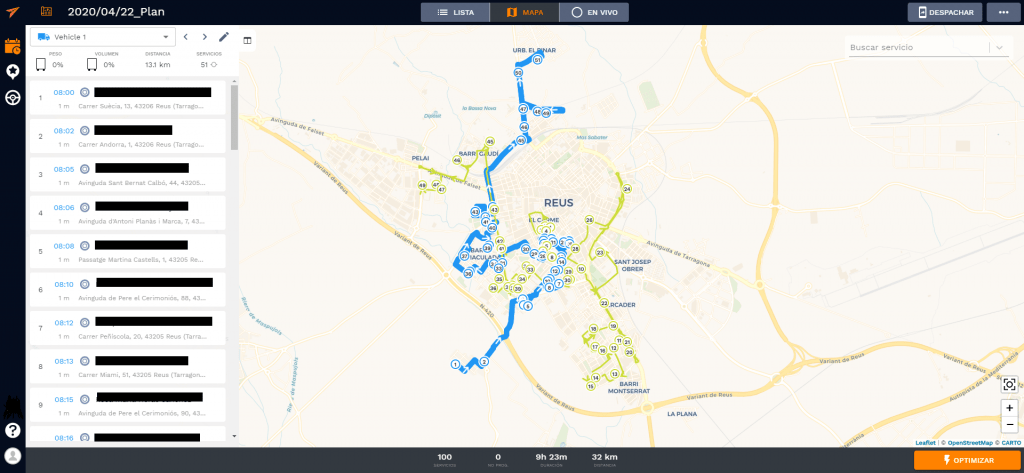
In this example, we have assigned to each of the services in each zone a Requires restriction depending on the zone that corresponds to it. This way we can group them according to the image.
The second step is to assign which routes you are going to or are going to cover which zones. To do this, we simply must Edit The Provide restriction Of each of the routes and Assign it the same label as the routes What we want you to do.

All that remains is to press the optimize button to achieve the optimized route through zones. As we can see in the image, the services have been assigned exactly according to the areas we had indicated.

You can then download an example XLSX document with the services. You can see that there is an extra Requirement column, and we must assign it to the Requirement concept when uploading the XLSX to the platform so that it automatically assigns the zone label to it.
Sample document for getting on Highway Download an example XLS
Finally, after having the routes optimized, we could play to modify some route service, assigning it manually and see if there are any improvements or if it can be distributed in a more balanced way, but we will see this last tip in future chapters.

Sant Jordi is always a special day, books, roses, queues and people, lots of people. Everyone is out on the street, enjoying a magical day for both children and adults. It is the day of the year when the most books are sold, 7.5% of annual sales In the city of Barcelona.

This year will be special. We'll have to spend it at home, enjoying a good read, our recommendation for these days The Black Swan by Nassim Taleb. This year we will save ourselves the hassle of Las Ramblas and we will have to buy the roses online. Without a doubt, a special year.
We want to take advantage of this important date to see the success of initiatives that, in a normal year, would hardly have achieved such overwhelming success.
One of our customers Santjordiacasa.com is using Highway as a tool to optimize the distribution of roses on such a special date as Sant Jordi.
Thanks to the power of the Highway route planner, they have been able to grow in deliveries and reach customers that would have been impossible for them before.
Like them, hundreds of other customers are entering a world such as home delivery. A channel that had often been completely forgotten. Thanks, or unfortunately, COVID-19 has forced the launch of new marketing channels such as Ecommerce and its own distribution and home delivery.
We are seeing this in our traditional customers, distribution companies to the HORECA channel that are converting to home distributors overnight.
Pastry shops such as Cropics they were able to deliver all the Easter monkeys in record time and have the detail of leaving a monkey at my wife's grandmother's house 😁. These types of details make being able to help small businesses make you proud of the work you do and of seeing how you can help more people around you.

We are in a very difficult time for many companies and families. There is little help to get through this crisis and reaching those people we can help is always a challenge. I encourage you to share our story, the story of our users and customers, companies that are embarking on a new adventure, delivery. Without experience, without processes, but with a desire to fight and face the corona, you are not alone.
We won this together.

The distribution on demand is an industry that is growing at a very high speed. New companies appear every day, especially in the market for food, beverages and deliveries of perishable products. And the competition is wild. Efficiency is a key metric in the “I want it all and I want it now” era and the most critical part is what happens from when a new order is placed until it is delivered.
Today I want to focus on the problem of sending new orders, that is, how to decide which courier service the order should be assigned to when an order enters the system. This is because the dispatch today is not addressed systematically. Optimizing the dispatch system can minimize delivery time and improve customer satisfaction.
The operating paradigm of companies that deliver on demand can be divided into two different types:
- Operations based on a single warehouse are those operations focused on a single tank. This warehouse has several dealers and the programming is done once to obtain an order list; usually grouping orders by area. Amazon Prime is a good example of this paradigm.
- Operations based on multiple warehouses are those operations that rely on choosing the order in one of the multiple warehouses and delivering it to a customer. In this case, the delivery people are scattered around the city, and once a new order arrives, it is assigned through a shipping process to one of the multiple delivery people. Companies such as Uber, Just Eat, Delivero, etc. operate this way.
The problem of dispatching is solved more or less satisfactorily in the first scenario thanks to the possibility of linking together a list of deliveries and considering it as a Traveling Seller Problem (Traveling Salesman Problem) with some pre-clustering restrictions (OK, I know that TSP is an expensive problem, but... come on, it's about Amazon).
On the contrary, in the second scenario, it is not so clear that the problem is being optimally addressed. How can a new incoming order be added to a running scenario? There are tons of variables to consider:
- Can the courier make multiple collections before starting to deliver?
- Can an already assigned order be reassigned to another courier service?
- Do all orders have the same priority? (for example, all orders must be delivered no later than 30 minutes after placing them)
Do orders need to be delivered by a particular vehicle? - ...

Modeling this scenario can be quite challenging, and that's why SmartMonkey has been working on this problem for a while. We call our solution Online Programming Optimization Model (OSOM) (Yes, branding isn't one of our strengths 😅, but phonetically it sounds like “incredible” and that's pretty fun). OSOM can model business restrictions and find a feasible solution to the dispatching problem.
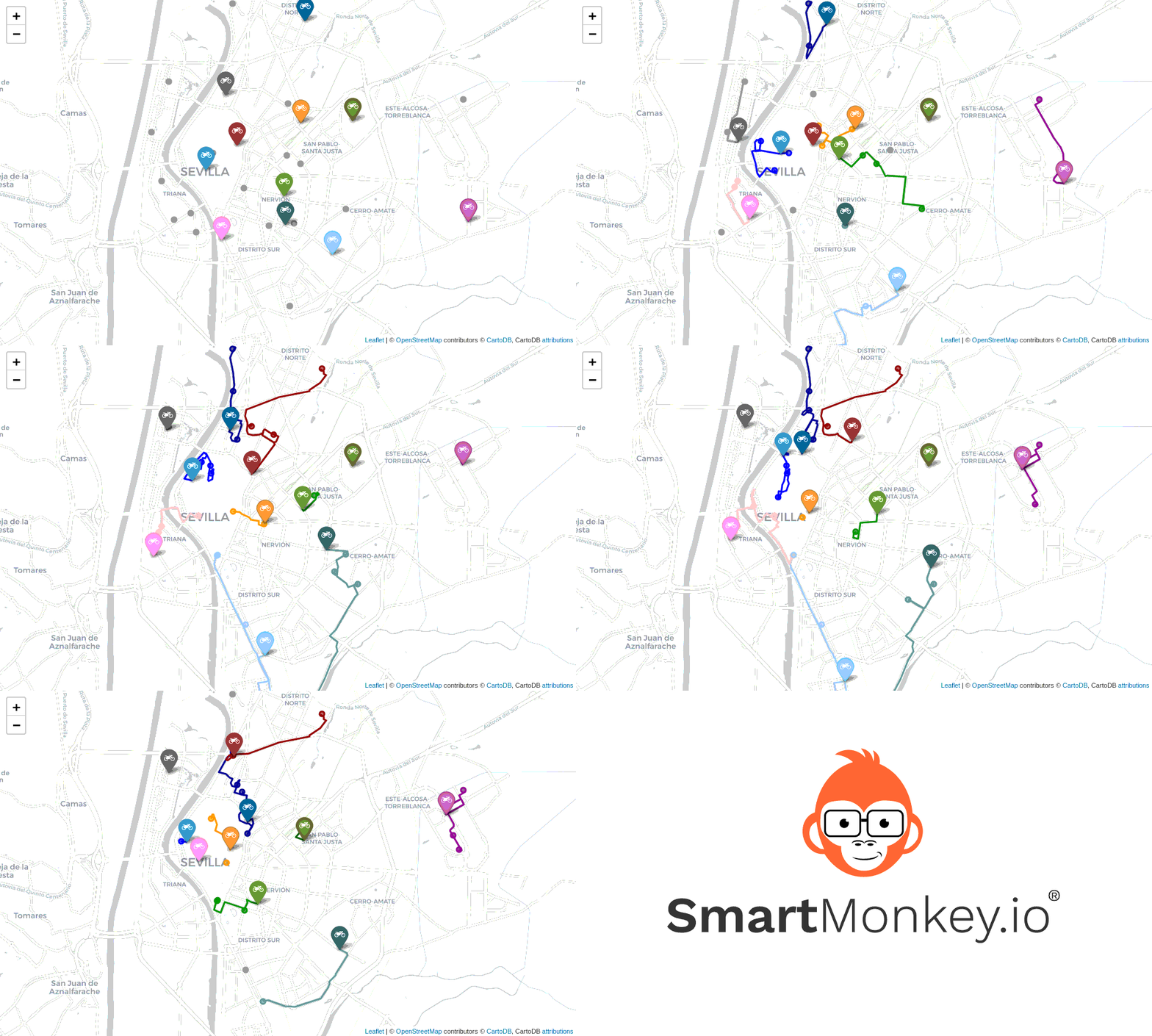
In the simulation below, we have modeled a world where:
- A courier service can be assigned multiple pickups and deliveries at the same time
- and the first next service of each messaging service is fixed and cannot be reassigned in subsequent iterations.
The visualization contains twenty iterations of the world divided into two steps:
1. New incoming services are marked in gray.
2. Services are dynamically assigned to deliverers to optimize overall delivery time.

I want to share a personal experience that matters. Smartmonkey.io is headquartered in Barcelona, the second region with the most Coronavirus infections in Spain. The second worst country in the world that is dealing with this virus.
Hospitals in our area are about to be overwhelmed by the demand for ICU patients. According to friends who work in hospitals, the capacity of ICU beds in the region of Catalonia is about 800 beds, of which 600 are currently occupied. But we are still a long way from the top. Studies suggest that it will be at the end of April . Even so, 4 long weeks with the exponential growth of infections and expected deaths. Tragedy is the smallest word we could find to define this situation.

But it's not all darkness and death. A few days ago, a guy from Canada was starting to use Highway, our route optimizer. Use was normal for new customers, Testing the examples , taking their first small steps in a very powerful tool, but at the same time easy to put into operation.
We always like it talk to our new users . Not only is it very useful to know more about them, but being able to provide the best possible customer service is priceless. Sometimes you find incredible projects behind @gmail .com accounts like Ahmed Sagarwala's father-in-law in Canada.

It is helping not only the poor, but also people who have decided to isolate themselves to prevent the spread of the virus. Delivering medicines to these people is not just worrying about them, but doing everything they can for society. We are very proud that yesterday 16 people received help thanks to Ahmed's father-in-law and Highway. He told us that next week it will increase to 50 or more. We'll be here helping them.
If you read this and know someone, we could help. Spread the word. We know how difficult it can be, #quédateEnCasa and support Ahmed and others around the world.
Xavi Ruiz, CEO of Routal

We are at war. Wars tend to happen far from home. But now, all of humanity is fighting (or will fight very soon) from their own homes. Follow public health guidelines such as #quedateencasa it will make us win. There are not enough hospital beds to process the demand generated by the Coronavirus. No country is prepared for such an increase in demand for critical patients. Then doctors have to choose who lives and who dies. If you don't want to play Russian roulette, my advice is to stay home. You'll reduce your chances of playing a very dangerous game these days.
Why isn't this just a health issue?
This thread is causing people to change their normal patterns. In many countries, fear causes irrational decisions to be made. We've seen people buying toilet paper for the rest of their lives. Fear causes people to act in ways we couldn't imagine. Fear saved us for the last few million years from being eaten by a lion. Fear will save us (Spanish).

The good thing about this crisis is that people are realizing the importance of the supply chain in their lives. Without trucks there is no toilet paper. That can't happen, period. But in a period of time when demand increases, normal ways of doing logistics tend not to meet the necessary demand.
These moments require help, which requires tools that make warehouse life easier, more reliable and able to adapt to unforeseen events that will surely happen again. The real question is when this will happen again. We just have to start getting used to it.
It's all a logistical problem.
It's not just supermarket logistics that are important. But healthcare logistics are key to maintaining human life expectancy. We're talking about compliance with basic materials, from whey to pills to laundry. Hospitals are complex production lines where people come in sick and come out cured.
A few weeks ago I was talking to one of the innovation managers of the ICS (Institut Català de la Salud — Catalan Institute of Health) on the future of hospitals. He told me that hospitals as we understand them today are going to change a lot. There is a huge tendency in the healthcare field to move patients from large and expensive hospitals, where they tend to stay for longer periods, to their homes as quickly as possible. Not only because it's cheaper for public health (40% savings) but because studies show that Staying home improves people's recovery
These benefits create a new logistical challenge. Make your healthcare team mobile. The main difference between a delivery company and Hospitality at Home is the cost of employees. The cost of a driver is relatively cheap, but a medical team comprised of a doctor, a nurse, and medical supplies is not comparable. Thus, every minute you can save them, in their trips, planning... is a minute in which you can treat more patients. Productivity isn't going to be like having them at the hospital door next to the door, but as much as we can optimize their routes, the less they're going to waste travel.
But how does Routal fight against COVID-19?
Like any good story, we have the bad guy: the coronavirus. The good ones: medical equipment. The problem is that the bad guy is winning the battle. The secret weapon: Routal . If you don't know us, we help companies with last-mile logistics processes optimize their routes while learning how their operations behave to improve operations the next day. Our goal is to make your last-mile operations as efficient and realistic as possible to make appropriate decisions. We have a mantra:
Machines solve problems, humans make decisions

The Hospital at Home teams from Hospital Sant Joan de Déu they are fighting this villain. Our technology allows them to focus on what's important: treating their patients in the best possible way while protecting others from infection by staying at home. We take care of your planning, making it as efficient as possible in seconds.
We're simply going to win this war.
If we stay at home
Winning a war has never been easier
Do you want to know more? Request a demo in our chat and we'll show you how to improve your operations by up to 30%
Sorry, no blog posts were found for your query.
Move the world smarter


.png)


